
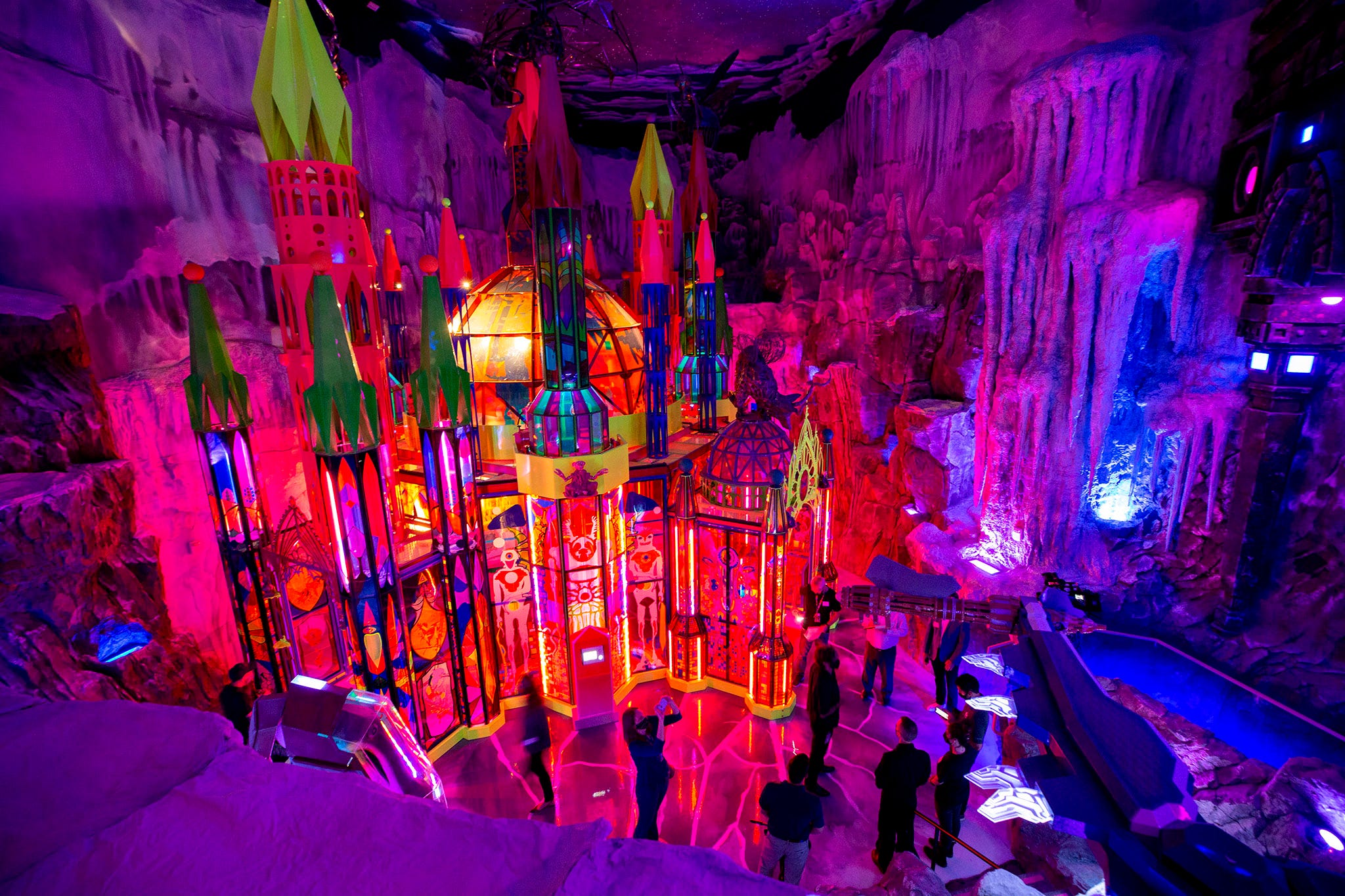
I’m at the tail end of a Christmas vacation in Denver, Colorado which has mostly consisted of me lazing about and catching up on side projects after a burnout-inducing semester of work, but the one thing I really wanted to do was go to Convergence Station, the warehouse-sized, immersive, interactive exhibition by Meow Wolf.
Convergence Station is an experience that is presented almost entirely diagetically (that is, in-fiction): from the front doors everything in the building that does not require real-world signage for safety or fire code’s sake is presented as being a part of an interdimensional transit hub put together by the Quantum Department of Transportation, a sort of ominous, maybe malicious technology company that handles transit after “Convergence” brought together a collection of worlds, including Earth, into a sort of quantum overlap.
Non-diagetically speaking, it’s a freeform, open-ended set of rooms, each of which is from one of several of the Converged “worlds” and connected to each other in strange, fun ways. These rooms contain art, mostly either dioramas built into the room or tactile sculptures the crowd is encouraged to touch, and also contain a certain amount of interactables: buttons and knobs and other more complicated contraptions you’re meant to play with, as well as a certain amount of screen-based installations (we’ll get back to those).
Ultimately, the angle I was most interested in experiencing Convergence Station from was that of interactive storytelling: as a part of buying your ticket to the facility, you can optionally buy a “QPASS” (read: a card with an RFID chip in it), The pitch on the QPASS, directly from Meow Wolf’s website, is as follows:
The QPASS is an optional RFID card that transforms your visit to Convergence Station into an interactive quest. By unlocking digital content, the QPASS allows you to discover more about the citizens of the Convergence and explore deeper stories of their worlds.
So, to me, the understanding is that buying a QPASS is “opting in” to the narrative elements of Convergence Station, and very early on it becomes clear that there is an arching narrative surrounding four missing women tied to the Convergence, and culminating in QDOT’s construction of “The Last Stop”, an ominous engineering project that will bring the inhabitants of Convergence Station back home.
Ultimately, after about two hours and change spent walking around Convergence Station with my mom, I found the experience just shy of great in a way I found deeply frustrating, and I think a lot of that comes down to surprisingly universal game design issues, the same kinds of issues that plague exploration-based video games.
I think my problems can largely be summarized into three big lessons, which if anything were great examples in-person (literally) of how to guide a player through a game world.
I Did Not Traverse A Quantum Rift To Check Emails
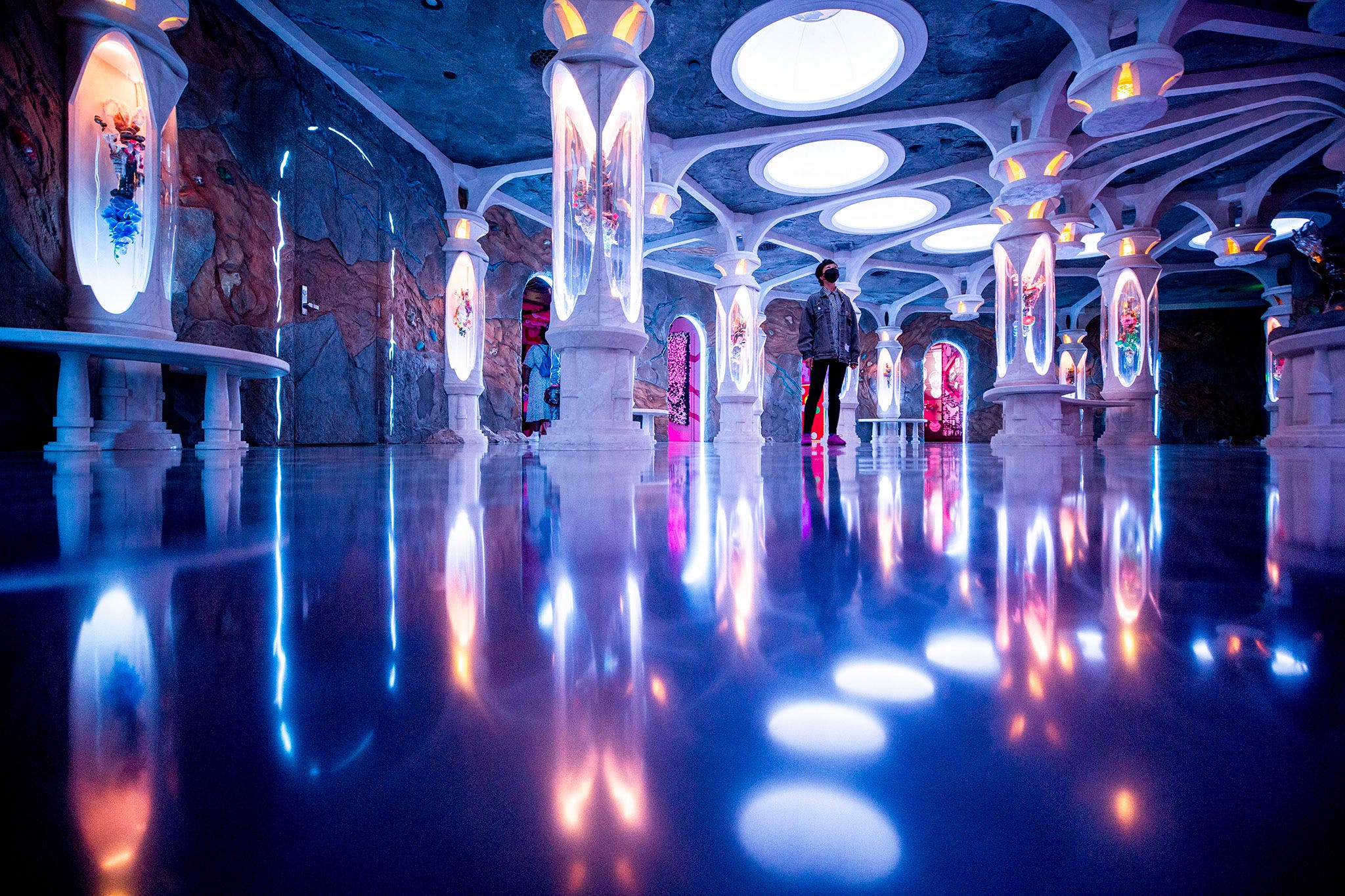
The absolute killer problem with Convergence Station is one of information being presented in absolutely the wrong way for the use case, in a way that gave me the admittedly unique experience of having to read sit through an arduous video game tutorial in real life.
So, as mentioned, buying Convergence Station’s QPASS opts you into the central narrative of the installation, about four missing women with close ties to the eponymous Convergence event, but it’s probably worth noting how the experience actually begins, which is that you take an elevator ride (sorry, “quantum train”) up into the experience and are dumped into C-Street, a sort of Lower East Side-by-way-of-Rick and Morty, with a dozen-or-so page travel guide that mostly contains very high-level setting information and not a ton of direction.
One of the first things you will see in your sightline, with a big glowing interaction point you’ve been told to keep an eye on so you can “boop” your QPASS (that is, rub your card against the RFID sensor), is one of many “Memory ATMs”. Memories are currency in the world of Convergence Station, and you will be accumulating memories throughout your adventure via your QPASS, and thus, you will be accumulating little chunks of story as you progress.
But when you reach your first Memory ATM, you will have zero memories and a shitload of emails. Your ATM begins pre-loaded with about a dozen or so page-long emails written to you by in-universe characters. This operates as the closest thing Convergence Station has to a quest log: attempting to guide the player to things of interest around the installation, but it’s presented with no hierarchy of importance nor context, so when you’re all of five minutes into your journey, it’s a bunch of “Glup Shitto wants you to go collect the Scungo down in Peebus Row”.
I’m relatively familiar with this sort of proper-noun laden clumsy worldbuilding, so I just sort of picked the one that was the most straightforward-sounding to focus on, because there was no way in hell I was going to retain more than about 3 made-up words in my head at once. My mom read through the same emails and looked at me with a look of genuine concern that I assume she also would have given me if I dragged her to a four hour long bunraku performance presented only in historically-accurate Japanese.
The obvious problem here is I don’t want to be in a fully immersive installation art exhibition to read a bunch of emails on a wall kiosk, but I also kinda have to do that because there is no other direction presented at the beginning. The only other worldbuilding I’ve been given at the outside is the travel guide, but guess what? I also don’t want to be in a fully immersive installation art exhibition in a corner wherever the light is good enough to read Rick Steves’ Guide to Peebus Row. I want to start fiddling with shit and wandering around and exploring.
This fundamental contradiction, of having to derail my exploration in order to get context for what I’m exploring in the most annoying way possible, largely permeates through the exhibition. As you accumulate memories with your QPASS, always via small kiosks with screens around the building (I have no idea what these are called in-universe, we almost immediately just started calling them “boops”), collecting enough of them triggers a short animated movie of a “memory”.
Psychotically, these movies will play on the boop and run about four minutes each, which would be fine if this was a video game and I triggered a cutscene, but I am stuck watching this video on a tiny screen on a physical object, which is unpleasant, but it’s a physical object that other visitors need so they can progress their storylines.
More than once, I found myself cringing and wishing a memory would finish faster as a physical line of people formed behind me waiting for their chance to boop the boop. Conversely, sometimes I was stuck behind someone else watching a memory, and in all of those cases, on top of the obnoxia of having to wait, there was also the awkward element that the video they were watching was one I was about to get, so I was kinda half-watching it from a distance from a cockeyed angle and then functionally rewatching a clip I’d already sorta seen when it was my turn to boop.
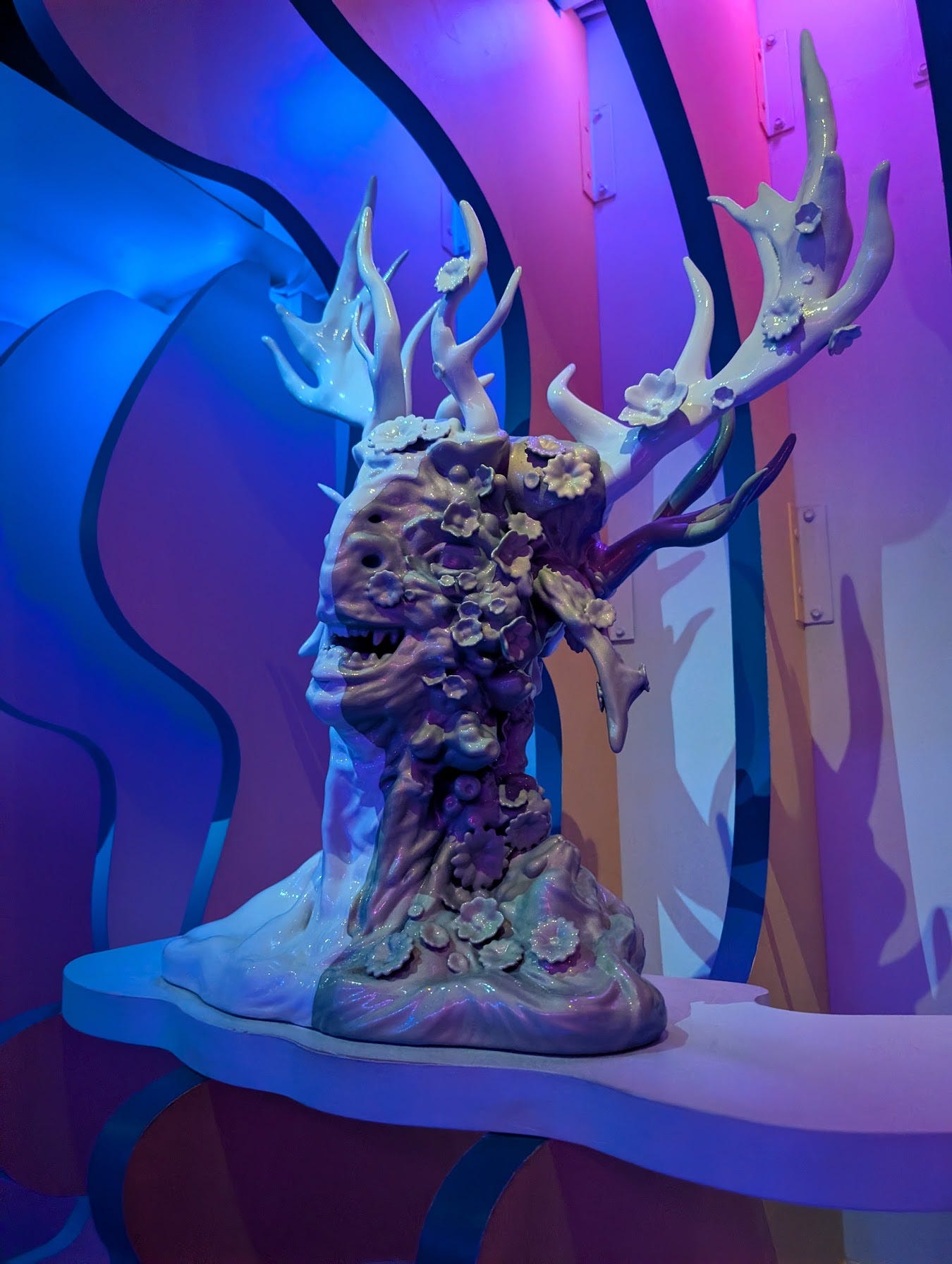
This delivery mechanism also totally falls apart when it comes to multiple people in the same group. My mom and I both had QPASSes, and as a result we got into a rhythm of one of us booping, getting some information, and the other having so sort of sheepishly boop afterwards and skip through all of the same stuff they just watched. Even more annoying, at some point I got one boop, and thus one memory, behind my mom, and I wasn’t going to go back through other rooms to hunt for the boop I was missing, so my QPASS became functionally useless. Since players seem to mostly be given their memories in a linear-ish order regardless of their location in the installation, my QPASS would never yield information or a memory that my mom’s didn’t already get.
Other information delivery mechanisms were similarly sharing-unfriendly. The space had quite a few physical books you could flip through, which, I’m not blocking traffic in a major thoroughfare of the exhibit so that I can read a fake book, I’m sorry, and a computer terminal had a similar issue.
In all instances, the problems and the takeaways were thus:
Vital context required to understand both the explicit plot as well as the broader setting “story” of Convergence Station required me to pause my exploration of the environment to get basically a big info dump of text/video. Information about the world should be in the world, not next to it.
Locking that context behind physical objects designed to be interacted with by only a single person lead to major information redundancy issues as well as literal queuing problems.
In an installation environment, people are going to be in groups, and there are going to be a lot of people who all want to interact with any given element at once. Bottlenecking should be minimized, and the base user experience should assume a group as the fundamental unit, not an individual.
Which Of These Ballsacks Do I Touch To Make The Story Progress
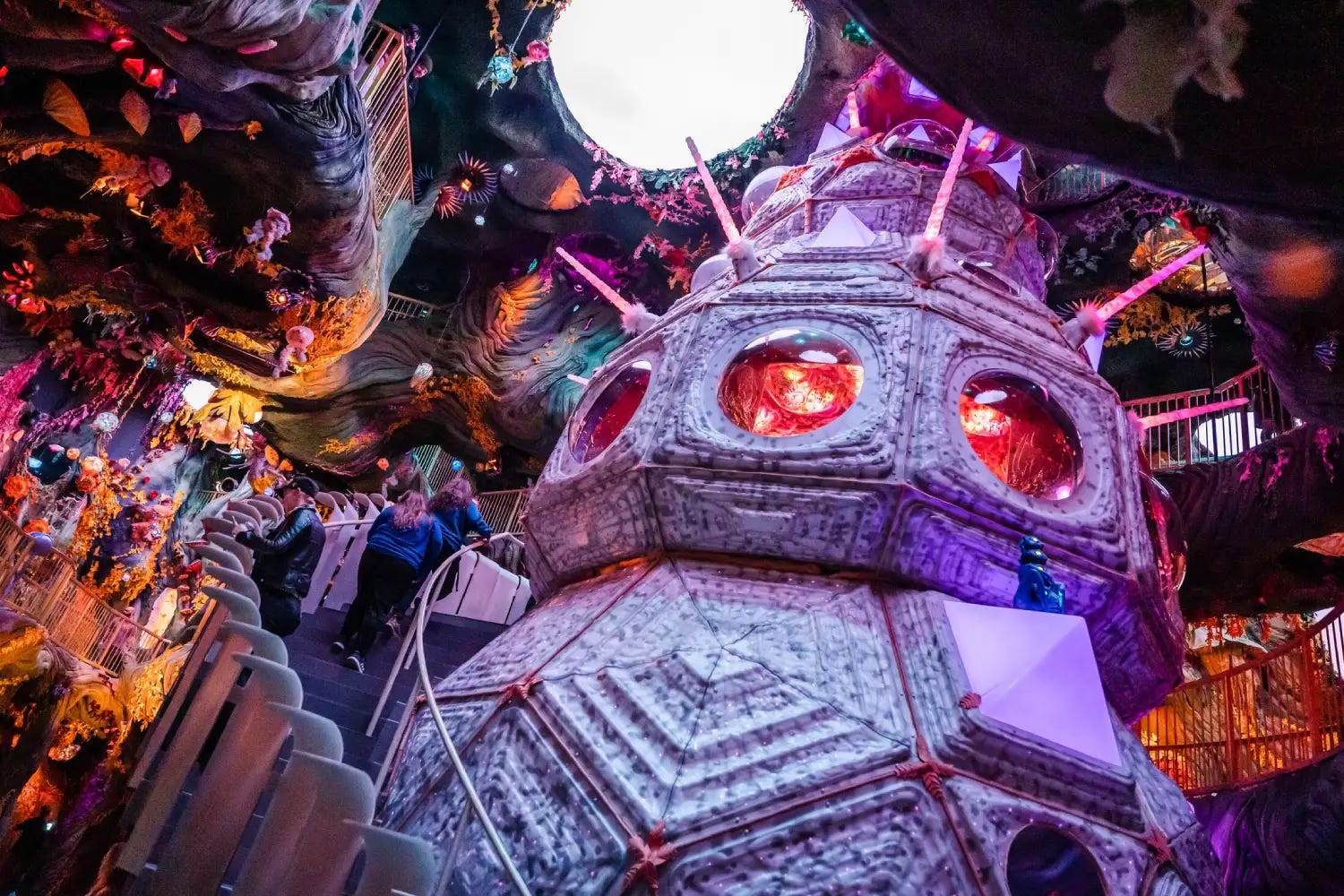
The previous section might imply that there’s no worldbuilding information placed into the exhibition itself, and that’s not entirely true. It would be more accurate, however, to say that what information exists in the rooms of Convergence Station are islands of context in a sea of nonsense.
This isn’t entirely a fair reading: Convergence Station is primarily an art exhibit, so the primary purpose of the space is to present interesting pieces of installation art, not all of which is meant to directly tie into the metaplot of Convergence Station, but with the exhibition focusing entirely on strange, otherworldly settings and fantastical things, there is no easy way to distinguish which of the dozens, maybe hundreds of points of interest in a given room contain useful information or an interactive element, and which are just Neat.
So, an aside here that I promise is relevant. In classic first-person shooters, especially the classic-est first-person shooter Doom, the levels often were riddled with secret rooms and stashes for careful players to find. However, maybe as an intentional design decision, maybe due to the limited graphics options available at the time, usually there was very little visual indication where those secrets actually were. As a result, players would just basically thrust their character against every wall in the game, mashing the interact key in the hopes of accidentally finding a secret switch or fake wall. This activity, of attempting to brute-force find environmental interactables by thrusting against every available surface, is commonly nicknamed “wall-humping”, and I found myself doing a lot of wall-humping in Convergence Station.
My mom and I walked around the exhibition kinda just touching everything: pushing against walls, fidgeting with sculptures and things mounted on the walls, rubbing our QPASS against basically anything with a light, just because in this incredible, fantastical world of wonders and creativity it was profoundly unclear what category any given object fell into:
Is this just a pretty piece of art/Instagram bait?
Is this some sort of simple interactive toy?
Is this a puzzle, and I need to learn how to solve it?
Am I missing something, some knowledge or some memory, that is needed to complete this element that I need to go hunt down and come back later?
Without clarity as to what parts of Convergence Station are which, I found myself aimlessly stumbling around its rooms, never sure if I’d missed something important or if I needed to come back, or if I should be remembering the text on a poster or the contents of a diorama or if it’s just for show.
I’m not necessarily saying I should be spoon-fed the plot of Convergence Station, I think the broad appeal of this sort of thing is the mystery and the thrill of the investigation. However, with such an absolutely wack signal to noise ratio it felt less like I was investigating anything or exerting my exploration skills and more like I was just stumbling against every wall waiting for something obviously important to jump out at me, and if I miss something, then fuck it, because there was kinda no way I was gonna find it.
This culminated in a large, naturalistic environment which dominates a single, multi-floor room, where the walls were frequently punctuated by plastic glowing… objects.
They were ballsacks, they looked like balls. But they were clearly important balls, lit and textured different from the wall around them and clearly exhibiting tactile sensors. But I had no fucking clue what they did. In one room, another guest mentioned that if everyone touched each ballsack in the room simultaneously, something should happen, but nothing did when we attempted it, and none of them did anything outside of that room either. But I was so desperate for any sort of interaction, for context, for a puzzle that every time I encountered a ballsack, I gave it a sort of dejected rub in the hopes of triggering some sort of event. But, as often happens when you rub a mysterious ballsack, all I was met with was disappointment.
I suspect this is a problem that might happen less in Omega Mart, Meow Wolf’s installation in Las Vegas which depicts a sort of surrealist grocery store, because that environment sets a baseline that guests are more immediately familiar with traversing, thus allowing the important elements to be easily identified. I know what sort of objects don’t belong in a grocery store, I know what the objects in a grocery store are and do, I do not have similar baseline knowledge of the Forest of Ballsacks.
Video games actually have a very similar problem nowadays. As video game graphics have gotten better and better and everything in a digital environment is rendered in extreme detail, which implies importance, it’s become increasingly difficult for players to identify what parts of the game world matter to them, what parts are interactive.
Spawned from this problem is the great “yellow paint” debate: to direct the player’s eye and diagetically note that some part of the game world is important to the players, some designers will put eye-catching UI elements, oftentimes a coat of yellow paint, on objects of interest. Some players consider this demeaning or a dumbing down of games, but without the yellow paint players often do not have the necessary information to identify objects of importance in a rendered world. In an environment of near-total visual verisimilitude but extremely restricted dimensions of interactivity, something beyond the realistic is required to identify what is inherently important, because the real world does not possess a concept of inherent importance. Convergence Station is direly in need of yellow paint.
Also very much not helping the fuzzy distinction between signal and noise was the fact that multiple interactive elements of Convergence Station seemed to just not work. A wall of pachinko machines clearly tied to some sort of locker combination puzzle just simply did not work, and the aforementioned Room of Ballsacks did not do anything when my group tried to activate it. Fan sites for Convergence Station note that several elements of the exhibition are notoriously glitchy or often broken.
This is a self-compounding problem: not only are, you know, some of the interactive elements of Convergence Station broken, which is inherently bad, but when you’re at an element that is working oddly, you can never be sure if you’re missing something or if the thing in front of you just flat doesn’t work.
At the core of Convergence Station are these big problems, which are very hard to solve:
In a completely unfamiliar environment that is specifically peddling in strangeness, how do you identify to players what aspects warrant further attention? How do you communicate the rules of how the interactive elements should work?
How do you balance keeping the world mysterious with rewarding player investigation?
How do you properly signal to a player what is a dead-end, versus what they should keep prodding at?
I’d Love To Help You Save Convergence Station, Quick Question First, Who The Fuck Are You?
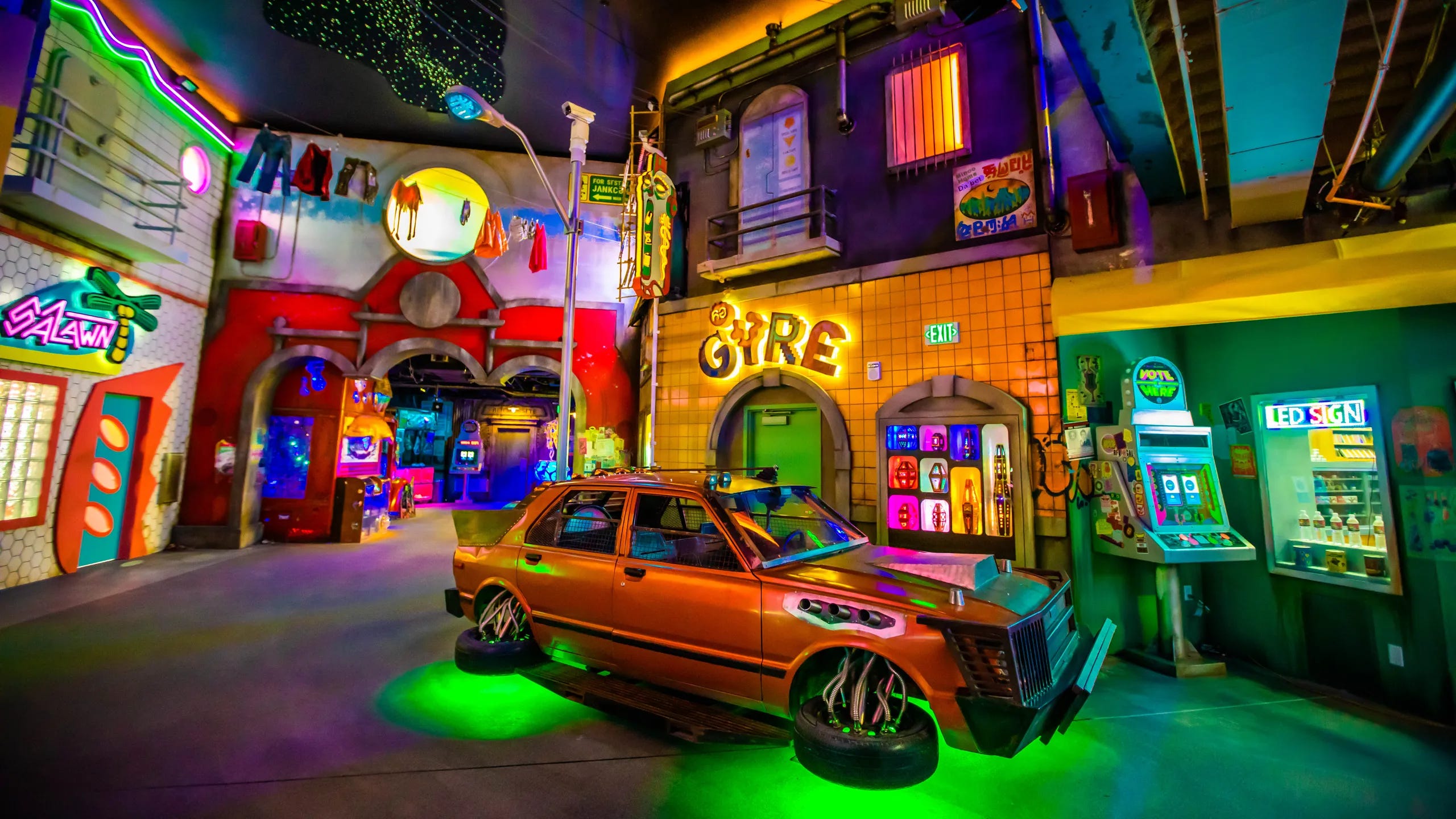
Ultimately, some of the above problems I may have been able to push through with dedication and focus, but ultimately my desire to crack the secrets of Convergence Station were undercut by the simple fact that what plot I did get just… wasn’t very good.
Spoilers for Convergence Station follow.
Early into your time exploring Convergence Station, you start receiving messages from “Whistleblower”, who warns you that QDOT is up to no good, that you need to collect memories, that you need to stop the Last Stop project. The consequences are told to you plainly: if the Last Stop is activated, it will erase all memories people have of the Convergence.
Oh. Uh, okay. I’ve only been here for like fifteen minutes, so I’ll be honest, I don’t really have much stake in this world or anyone in it, and hitting everyone here with a bad bout of amnesia isn’t great, but when your apocalyptic stakes are equivalent in effect to the CTE suffered by your average NFL quarterback it’s not exactly inspiring strong motivation.
But, whatever, I suppose as we explore this space we’ll learn more about these people and this world and I’ll grow fond of Convergence Station and want to save my memories of its wonder and whimsy.
This does not happen. Here is a summation of the major character events I experience in Convergence Station.
My mom and I walk into a room close to the entrance to Convergence Station and watch a short animated movie featuring characters we don’t know doing things we don’t understand. I realize, just now, writing this, that we walked into the ending of the story, approximately 40 feet from the entrance, about fifteen minutes in to our time there. In the moment, I have no idea what’s going on here, and mostly just ignore this, moving on to a room full of alien gophers. Why the fuck would you place the ending of the story in a room 40 feet from the entrance.
Wandering around C-Street, I find an apartment directory, which is dialable! I punch in a few numbers from the directory at random, and am greeted with short, contextless movies of characters I don’t know. One of them doesn’t even turn to look at the camera. Another one talks for a bit, but they’re not subtitled and the room is loud, so I have no idea what they’re saying. I abandon the directory.
We collect the first of the four main memories, the story of a Denver bus driver who finds a portal to another dimension and drives her bus into the Convergence. She has a cat. I don’t really know what her whole deal is other than “is a bus driver, finds portal”. The cat has more personality.
We see an informational video from the head of QDOT. He is comically evil. He literally has horns.
We collect the second memory. There’s some murmuring priests and something about a big organ. I explored the space we found this memory in, I have no fucking clue what this priesthood or this organ is about.
The whistleblower reveals their identity. I do not know who this person is, but it’s framed like it’s supposed to be important. I think I recognize her from the ending.
My mom and I get no more character moments at all for forty minutes. We look at each other when we realize we’ve looped back to the entrance, and decide to hit the gift shop and go.
Convergence Station is ultimately sold as an interactive exhibition depicting a place, and for better or worse and unlike something like an Omega Mart, it has elected to specifically depict an inhabited place, in parts a city. This is supposed to be a place people live and form memories, I’m supposed to care that the inhabitants of Convergence Station are at risk of losing their memories. They run fake news programs on the TVs showing the current events of this world and talk about upcoming fake sports games between rival teams across the Convergence. But I do not give a shit about any of this because there’s no characters here.
To be clear here, this is not necessarily a plea for Disney-style character actors to walk around going “Good morrow fair space traveler, I am Dunko Chuggins, welcome to my Space Restaurant!”, but I do think there’s a reason that other attempts at creating fully immersive installation spaces (such as Disney’s Galaxy’s Edge) does have them. I think the thing that really elevates the verisimilitude of these sorts of installations is the weaving of character plots into the world, giving you something human and emotional to latch onto as you explore.
There are a lot of ways to implement this, as many ways as there are ways to see the traces of real people in the real world. The spaces people live in grow to resemble them, decor speaks to the personality of the decorator. One’s actions in a space naturally create ephemera, like the groove of your ass left in your favorite chair. There was none of that in Convergence Station, no characters, no performers of action, nothing to elevate “this room full of a bunch of random shit” into a place where stories take place.
I explored all of the worlds of Convergence Station, and all of them made vague gestures of containing cultures or peoples or civilizations, but none of them were there. I couldn’t name a single character that lives in Convergence Station, I have no idea what their goals are, what they like, what they dislike.
Instead, all of the worldbuilding to find mostly came in the form of stagnant, stale facts. There is living slime on the walls. This forest is from the fifth dimension. Here’s some art. Whatever, dude.
Because of this, I really didn’t care about the plot being woven in the memories, because I didn’t care about the characters, and I didn’t really care about the world, because by all accounts it wanted to be an inhabited world, but it wasn’t inhabited, plain and simple. There were no fingerprints of character scattered throughout, and because there were no characters in the space, there were no stories in the space either.
It was just, ultimately, a bunch of rooms full of random shit.